Thanks to Checkology, young woman finds news literacy second nature
There is a moment in every student’s career when they stare at an assignment in boredom and ask: “When will I ever use this in real life?”
If the subject is news literacy, the answer is “every day.”
Just ask Mirudulaa Suginathan Yamini.
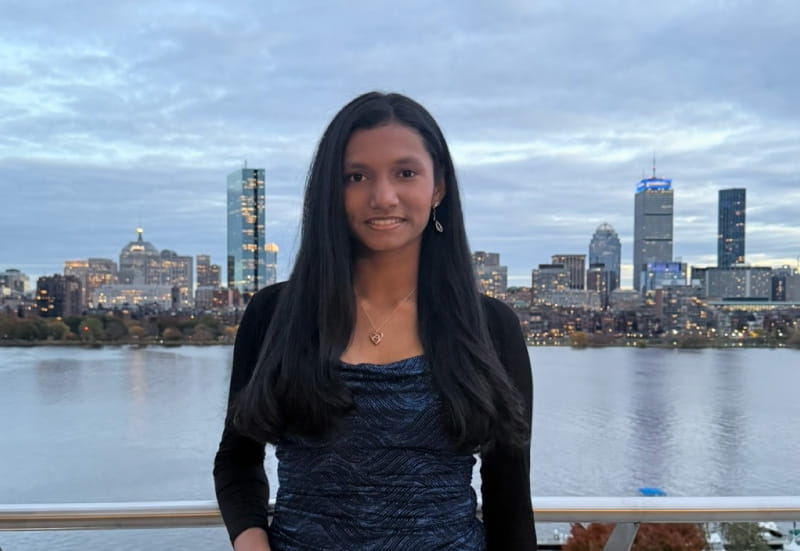
In 2021, when Mirudulaa was 13 and in the eighth grade, she became the youngest recipient of the News Literacy Project’s Gwen Ifill Student of the Year Award. Now a sophomore at the University of Massachusetts Amherst, she seamlessly applies the skills she learned from the News Literacy Project’s Checkology® virtual classroom to her college courses.
“I think it’s natural to fit in news literacy skills because it’s not something I think about when I use them. It’s second nature, like it’s ingrained in me,” said Mirudulaa, a biomedical engineering major. “I am definitely using my skills, since this profession requires a lot of research and the need to navigate misinformation.”
News literacy provides competitive edge
She has the instincts to question if an author is reputable, seek credible sources and consider the validity of information. An accomplished student, Mirudulaa is an undergraduate researcher in the Surgical Informatics Lab at Harvard Medical School and a Surgical Research Intern at Beth Israel Deaconess Medical Center in Boston. News literacy skills give her an edge in a fiercely competitive environment.
“This helps me in my research to make sure that the information I’m using in robotics, coding or whatever I am learning is accurate,” she said. “For instance, I had to research specific therapies for various diseases, and at first glance a lot of articles seemed accurate. But I would keep thinking back to these news literacy skills. With more thorough analysis, I figured out that some articles were not reputable, more personal opinions and ideas. And some hadn’t been clinically tested and proven.”
Sharing her knowledge
Without pause, Mirudulaa ticks off the steps she takes to ensure that the information she relies on is accurate and complete.
- Read deeper into an article.
- Explore the about section on a website.
- Find out who the publisher is.
- Learn more about the author and their credentials.
- Use multiple standards-based news outlets to stay informed rather than relying on one source.
Because news literacy is integral to her learning, Mirudulaa’s habits naturally influence the way her classmates think about information. “In group projects, we’re able to talk about sources they bring up to see which is more reputable. I often notice a significant improvement in the next batch of sources they bring, because they’re now instilled with news literacy education,” she said. “I’m able to spread the knowledge of news literacy, and I’m glad to do so.”
Mirudulaa credits her early introduction to news literacy for the leadership skills and confidence she has today. “I’m glad I had that training. It is incredibly valuable. I hope other students can learn news literary from a young age. Then they’ll have years of experience using the skills, which also will help them in the workplace.”
News literacy strengthens friendships
The value of news literacy for Mirudulaa isn’t just academic. It’s personal. She shares her knowledge with friends to help them better navigate online misinformation. And it’s had an impact. “The most important difference is how they begin perceiving the world around them. Some friends have specifically voiced that their skills were significantly better. News literacy has helped them understand the nuances of everyday life. I think this has made our friendships stronger because now we’re more easily able to discuss what we view online with each other. And we have a good understanding of how to communicate with our surrounding society.”
That is particularly true when it comes to social media. “The most important thing I learned is how to navigate social media safely,” she said. “Since I started using NLP resources much younger — around the time I started using social media — it was easier for me to navigate safely and be able to understand the content and identify bias or what might not be truthful, accurate information.”
But for Mirudulaa, practicing news literacy is not only about demonstrating skills. It’s also about living up to ideals. “I can portray the best version of myself and make sure that what I’m putting out to the world is as accurate as possible.”