|
An inside look:
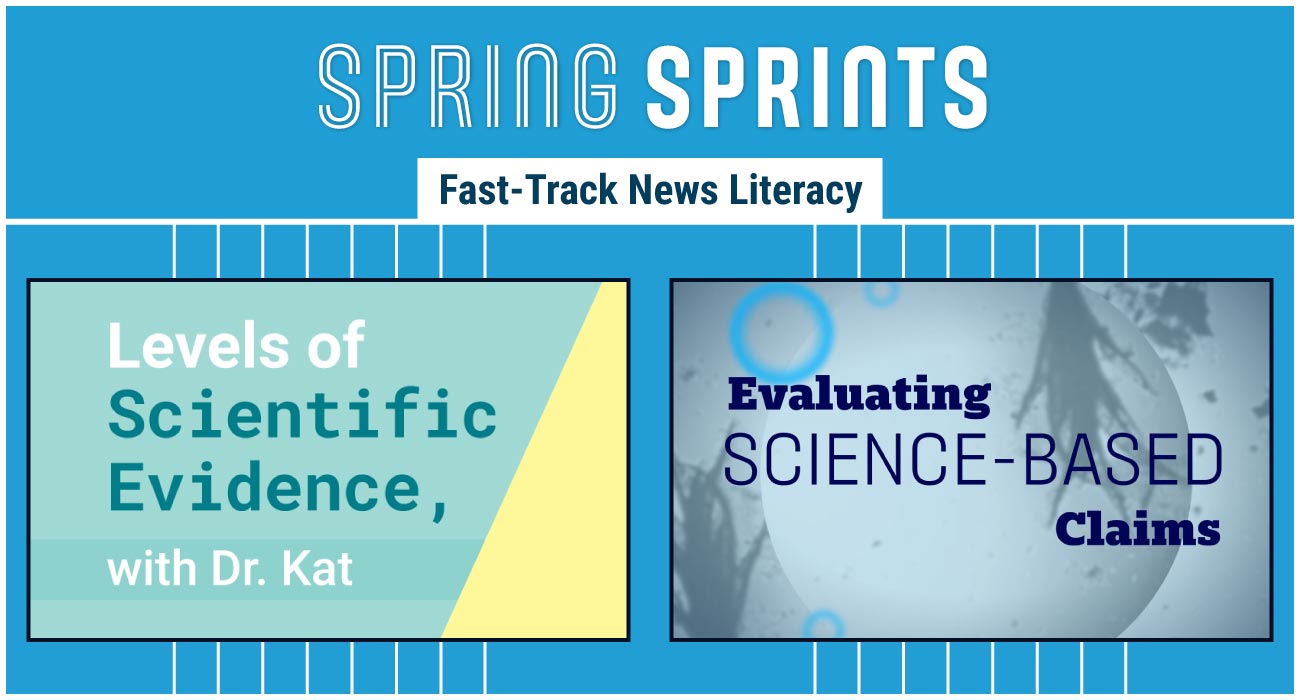
Levels of Scientific Evidence infographic

The school year’s wrapping up, but there’s still time to squeeze in some essential critical thinking skills! We’ve packed some of our must-use resources into brand-new weekly lesson-and-poster bundles we call Spring Sprints, making it easy to fit key news literacy learning into your schedule. One standout? The Levels of Scientific Evidence infographic, which pairs with Checkology’s “Evaluating Science-Based Claims” lesson to help your students sort fact from fiction.
Easy, engaging ways to use it
- Debate it: Give students different types of evidence (expert opinions, social media posts, scientific studies) and have them argue which is most reliable.
- Investigate it: Ask students to bring in news articles or viral posts and classify the claims using the infographic.
- Fact-check it: Have students research a trending claim and rate their sources using the evidence pyramid.
The “Evaluating Science-Based Claims” lesson takes this a step further, helping students think critically about science news and why misinformation spreads. These quick, engaging lessons give students real-world skills they’ll use far beyond the classroom.
Don’t miss out — grab the resources, join a webinar (more on that below) and help your students finish the year strong!
|
|
|
Insider spotlight
| Welcome to the Insider Spotlight section, where we feature real questions from our team and answers from educators who are making a difference teaching news literacy. This month, our featured educator is Candice Roach from Port Jervis, New York, where she teaches a middle school course called Multimedia Experience. To help students identify credible evidence, Candice uses resources like the “Levels of Scientific Evidence” infographic. |
 |
 |
Q: Evaluating evidence for its credibility is a foundational news literacy skill. What are key characteristics of authoritative sources and credible claims? |
 |
A: Not all sources are created equally. Obviously, peer-reviewed journals are going to be more authoritative than TikTok. Credible claims are those that can be verified. If a claim is online and true, it should be easy to find it in more than one place. |
|
Q: How is news literacy relevant to your teaching of research skills? |
|
A: News literacy is key to information literacy. Teaching students to find reliable, trustworthy information from verifiable sources is a research skill. It can be transferred to learn any content in any class |
|
Q: In your experience, what are some common misconceptions that students have about the credibility of sources? How do you address those misconceptions? |
|
A: Lately, students are too trustworthy of AI! Students tend to be trustworthy in general — if someone says it, they believe it. My job is to encourage them to do a lateral search or a reverse image search and verify the information is true before they share it. |
|
|
|
What's new?
⭐ New AI lesson!
In this lesson, students consider the impact of generative AI technology on the information landscape. They start by completing a K-H-W-L chart. Then students take a short quiz featuring AI-generated images and explore tips to determine whether an image is AI-generated. Finally, students will reflect on how AI tools have changed the nature of visual evidence. Intended for grades 6 and up, this lesson plan includes essential questions, vocabulary, activity slides, procedural directions and ideas for an extension opportunity. Download the lesson here.
⭐ Be featured in our educator spotlight!
Are you using NLP’s resources to make a difference in your classroom? We want to hear from you! We’re looking for passionate educators to share their experiences and insights in our Educator Spotlight. Interested in being featured? Complete the interest form here: https://forms.gle/pvzQPix7kAPmgYQp6
|
|
|
NLP events for educators
|
???? April 9, 5 p.m. ET/2 p.m. PT:
????Cracking the Code: How AI Shapes What We See (and What We Miss)
From shaping our social media feeds to influencing the news we see, algorithms and artificial intelligence are transforming the way we consume information. But how do these technologies work, and what impact do they have on our ability to distinguish fact from fiction? Join us for an in-depth conversation about the evolving role of AI and algorithms in news and social media. You’ll learn directly from reporter Mia Sato, who covers the tech world and AI’s influence for The Verge. Together, we’ll explore the rise of AI-generated content, machine learning systems that use data to shape our information bubbles, and the challenges posed by deepfakes. Throughout the discussion, we’ll equip you with strategies to help students develop a more critical approach to digital news consumption. Register here.
|
|
???? April 30, 5 p.m. ET/2 p.m. PT:
????Trial by Media? The Free Press and the Criminal Justice System
Join us for an engaging webinar – just in time to mark World Press Freedom Day on May 3 – about the work and impact of investigative reporters in the criminal justice space, and what students can learn from this fascinating field. NLP’s Brittney Smith and Jostin Grimes will lead a conversation with Meghann Cuniff, a legal affairs reporter known for her deep reporting on high-profile court cases (including recent cases involving Sean “Diddy” Combs and Meghan Thee Stallion). Meghann will discuss how she researches and reports on complex legal proceedings. Register here.
|
|
???? April 16-17 and May 7-8:
????30-Minute Webinar: Preview Checkology
Join us for an engaging 30-minute webinar to learn more about Checkology’s foundational lessons in essential news literacy topics and understand how to get started with the platform. The same material will be covered in both sessions. We’re holding multiple sessions of the same event, so pick the one that works best for your schedule.
|
|
|
|
Pencil it
???? April:
???? April 6: National Library Day
???? April 16: National Librarian Day
???? April 22: Earth Day
|
|
|