|
An inside look:
Understanding Bias

National News Literacy Week is here, and we’ve made it easier than ever to bring news literacy into your classroom — no matter how packed your schedule may be. Whether you have five minutes, half a class or a full period, we’ve got tools that fit your schedule and help your students build essential skills. One of the highlights this year is the ”Understanding Bias” lesson on Checkology®.
Bias can be one of the trickiest concepts for students to wrap their heads around. From personal opinions to systemic influences, learning to recognize bias is key to understanding the full picture behind a news story. The ”Understanding Bias” lesson breaks this down in a way that’s easy to teach and accessible for students at all levels. It walks them through identifying personal, ideological and systemic biases while building the critical thinking skills they need to evaluate news and information with confidence.
If you’re wondering how to fit teaching news literacy into your busy week, we’ve provided some additional options! To make things even simpler, we’ve created an Activity Planner that gives you a day-by-day suggestion guide. Whether it’s a quick discussion starter from The Sift® or a ready-to-use Checkology lesson, this planner is perfect for educators on the go.
Ready to get started? Make National News Literacy Week a meaningful experience for your students by exploring our webpage. Choose the resources that fit your classroom best and help your students develop the skills they need to confidently navigate and evaluate the media they encounter every day.
|
|
|
Insider spotlight
| Welcome to the Insider Spotlight section, where we feature real questions from our team and answers from educators who are making a difference teaching news literacy. This month, our featured educator is Juan Armijo from Las Cruces, New Mexico, where he is an Advanced Placement (AP) United States government teacher. |
 |
|
|

|
What's new?
⭐ New infographic!
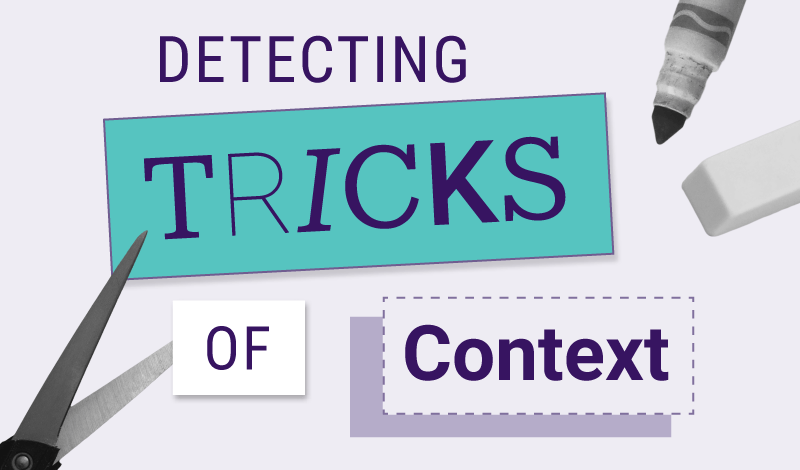
People who create disinformation designed to go viral on social media have an array of tools and tactics at their disposal. Simple tricks of context are one of the most common, mostly because they are effective and relatively easy to produce. Watch out for these four common tricks of context and download the infographic here.
⭐ Be featured in our educator spotlight!
Are you using NLP’s resources to make a difference in your classroom? We want to hear from you! We’re looking for passionate educators to share their experiences and insights in our Educator Spotlight. Interested in being featured? Complete the interest form here: https://forms.gle/pvzQPix7kAPmgYQp6
⭐ We’ve extended our complimentary NICKLpass offer for educators!
You now have more time to claim your accounts! We’re excited to share that our complimentary NICKLpass accounts will continue to be available for our educator community in 2025. Don’t miss out on this incredible opportunity! NICKLpass gives you seamless, paywall-free access to premium news content. Thanks to our partnership, we’re offering a limited number of complimentary 12-month subscriptions to The New York Times, The Washington Post and TIME magazine. Interested? Act now while it lasts! Claim your account here!
|
|
|
NLP events for educators
|
???? WATCH THE RECORDING
????Evaluating News Media Bias: A Nuanced Approach to a Vital Topic
We’ve kicked off National News Literacy Week! People frequently perceive and allege bias in news coverage, but what does this really mean? What makes a piece of news biased, and who decides? What role do our own biases play in our perceptions of bias? In this free edWebinar, we’ll help you teach this vital, controversial and complex topic in ways that empower students to meaningfully evaluate the fairness and impartiality of news coverage. Missed it? Find the recording here.
|
|
???? Feb. 6, 1 p.m. ET/10 a.m. PT:
????Hard hits, hidden truths: How investigative journalism tackled the NFL’s concussion problem
Join us for National News Literacy Week! Today, most of us know that a professional football player can sustain potentially devastating brain injuries after years of repeated high-impact collisions with other players. That awareness is due in large part to the reporting of investigative journalist Jeanne Marie Laskas, whose 2009 GQ magazine article, Game Brain, profiled scientists who had made a stunning discovery: Concussions in pro football players could lead to dementia. In this one-hour webinar, open to educators and their students and hosted by the News Literacy Project as part of National News Literacy Week, we will:
- Learn how Laskas conducted her reporting, despite resistance from the NFL.
- Learn about the watchdog role investigative journalists play in a democracy by documenting abuses by individuals, corporations and government entities.
- Explore free classroom resources for teaching about the watchdog role of a free press, including the “Democracy’s Watchdog” lesson on Checkology.
- Educators are welcome to join with or without their students. Register here.
|
|
???? Feb. 8, 10 a.m. – 6 p.m. ET/8 a.m.-3: p.m. MT:
????Boise State Writing Project & News Literacy Project
Hosted by the Boise State Writing Project and the News Literacy Project, this conference explores teaching our students how to differentiate fact from fiction, navigate society’s divisions, solve complex problems, and support their own and others’ well-being. Come to be inspired, share ideas and network with educators across the country. This conference will be held virtually. The $40 registration fee includes a conference ticket, access to all conference session materials, including session recordings, and your choice of an educational book related to the conference topics (that will be shipped to you). Register here. Questions? Please contact the conference coordinator, Jackie Miller (jackiemiller@boisestate.edu).
|
|
???? Feb. 11, 1 p.m. ET/4 p.m. PT:
????Fact-Check the Chatbot: Spotting Misinformation and Hallucinations in GenAI
A free, online workshop for grade 3-12 educators. We all know students are using GenAI tools like ChatGPT and Google Gemini. But how can educators support students to fact-check the chatbot? Join us for a 1-hour workshop designed to help students gain vital online research and reasoning skills in the age of AI. You'll learn how professional fact checkers avoid falling for misinformation, whether it’s human- or AI-generated, and practice identifying and evaluating credible sources. Then we’ll put what you’ve learned to the test with the latest version of our favorite source-checking game: Share or Beware! You’ll leave with ideas, teaching tips and ready-to-use resources to help students find reliable sources no matter where they click. Register here.
|
|
???? Feb. 11-13:
????30-Minute Webinar: Preview Checkology
Have you heard of Checkology (or even registered for it) but you’re still not sure how to get started? This webinar is for you! Join us for an engaging free session led by NLP staff to learn more about Checkology’s foundational lessons in essential news literacy topics. You’ll come away with a plan for getting started on Checkology and with practical tips for integrating lessons into your curriculum. (Bonus: All attendees will be automatically entered into a drawing to win a care package of NLP goodies!) We’re holding multiple sessions of the same event, so pick the one that works best for your schedule.
|
|
|
|
Pencil it
???? March:
✏️ March 4: National Grammar Day
???? March 8: International Women’s Day
???? March 9: Daylight saving time begins in some states
|
|
|