News literacy skills give students newfound agency
For years, two minor oversights in the Checkology® lesson “Practicing Quality Journalism” slipped by News Literacy Project staff, scores of educators and roughly 100,000 students.
Then last spring, two attentive students at a youth detention center in Rochester, New York, spotted the glitches and pointed them out to their teacher, Miranda Stefano, a librarian and educator with the Rochester City School District. Their validation was immediate.
“I saw their eyes light up. It was like, ‘Oh, this is nice, this is a good feeling’,” Stefano said. “I used it as a teaching moment and told them this is a really good observation, because even the experts get things wrong sometimes.”
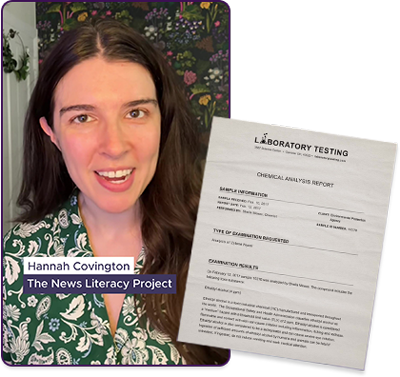
She then contacted the News Literacy Project, and staff got to work on fixing the errors — a video timestamp that was out of sequence and an incorrect detail in lesson material. Senior Director of Education Content Hannah Covington sent a thank you video to the students, and Stefano shared it with Christopher Smith, executive director of the district’s Home Hospital Instruction and Youth & Justice Programs. He was so proud of the students that he sent the video to district administrators.
“Never let anyone tell you that incarcerated students aren’t brilliant or capable of doing high-level work. Our students just proved that they can out-think the mainstream. Society often counts incarcerated youth out, writing them off as apathetic or behind. This is undeniable proof that they are sharp, analytical and intellectually gifted,” Smith said.
News literacy’s real-world value
Stefano, an educator for more than a dozen years, began teaching news literacy in 2018 using NLP resources, and this recent experience further cemented her belief that news literacy’s real-world value can’t be overstated. Committed to bringing these skills to more students, she helped lead her district’s successful application to NLP’s District Fellowship program, which provides educators with support and funding to create their own districtwide news literacy programs.
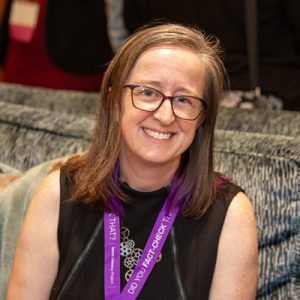
“I became a librarian with the intention of helping people find the information they need to succeed. Early on, I realized that misinformation was a huge barrier to that goal, and I have been on a path to share the skills and knowledge needed to overcome all the misinformation. Most of that knowledge, content and strategies comes from NLP,” she said.
A barrier is no deterrence to Stefano. She has dedicated her career to teaching in challenging settings — from schools for young students with behavioral and mental health issues to Rochester City School District’s Youth & Justice Program, which led her to the county’s teen detention centers.
Last year, when educators at the facilities realized that students had fallen for dangerous online health and wellness trends, they turned to Stefano. “I was approached with a desperate plea to teach lessons on not believing everything you see online. Their students were in very vulnerable positions. Teachers were scared for them.”
Relying on the News Literacy Project
She partnered with business teacher Mary Ann Holcomb for a onetime lesson on digital footprints — the trail of posts, likes and shares we leave behind online. Because these students don’t have access to the internet, Stefano created fake social media posts for job “candidates.” She then asked the students to look at the posts as hiring managers would when weeding out applicants.
Immediately, she saw the impact on students. The exercise made them think about content they had posted online and what a potential employer might think of them. “That was a change of perspective. They’ve never been in that position where they have the power to hire someone. That was a powerful moment.”
After this success, the administration asked Stefano to teach news literacy monthly to roughly 20 students. In one lesson, middle school students used fact-checking skills to determine if posts they’d seen about the haunting of a popular musician’s mausoleum had any credibility. “At the end, they were asking for more and more things to fact-check.”

Stefano also used sorting exercises to teach students how to identify different types of misinformation. “This is what I think Checkology and the News Literacy Project do well; they deeply define things. This gives students the power of language to identify what they’re seeing, to navigate it and figure out what to do next.”
She said the students were motivated to determine what was factual and what was fake and to act on their new skills. “It’s important to feel that agency when they get out, to choose information that’s going to help them and not hurt them and not come back here.”
Holcomb agreed. “I work closely with these youth and have seen firsthand how important it is for them to be able to make informed choices.”
Seeing potential where others don’t
The news literacy lessons resonated deeply, as the students’ engagement demonstrated. Even corrections officers in the classrooms were drawn in — sharing how they had been fooled or volunteering answers. Students who initially dozed or daydreamed perked up. “They heard the excitement and thought: ‘Wait, what am I missing?’ So, they joined in,” Stefano said.
While news literacy skills can’t give these teens the physical freedom that their peers enjoy, it can give them something else — intellectual freedom. The students started to think independently, shared what they learned with confidence and saw that others valued their contributions.
Adults need to know about this, Holcomb said. “Unfortunately, my students are often defined by their circumstances or past mistakes, and it can be easy for others to overlook their potential,” she said. “Our students are very capable of growth and meaningful change when they are given the opportunity, support and trust to do so.”
And for Stefano, the experience was deeply rewarding: “This gives me motivation to keep seeking out those students that are usually missed and who people have written off. I could see a lot of potential in a place where people don’t see that potential. I think it was the best teaching experience I’ve had.”
Due to funding cuts, the program that provided library services to incarcerated youth was discontinued for the 2026-2027 school year. Stefano is now teaching at a career and technical high school in Rochester.