In news literacy — and life — understanding comes when you pause, look, reflect
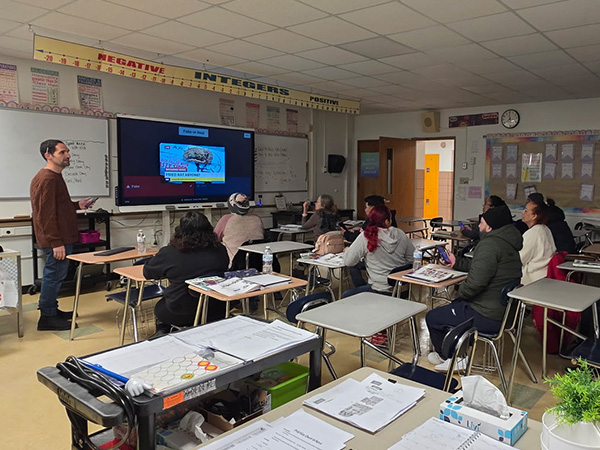
If you poke your head into Alex Luciano’s classroom in Central Islip, New York, any evening while he’s teaching, you’ll see him point to an image on the screen at the front of the classroom and ask, “What do you think is happening? What is this about?” Before anyone writes an answer, he will instruct them to pause, look, reflect. You might assume he’s teaching a news literacy class, and you would be both correct and incorrect.
Luciano teaches adult English as a second language classes using the same approach that applies to news literacy education, which he seamlessly weaves into his lessons. “One of the first things that we do are basic literacy skills of reading and decoding and inferencing,” he said. “We look at a picture or read a story and we pause; we reflect on it. Same thing with news literacy. You pause, you look and you reflect.”
He sees news literacy as essential to gaining fluency in a new language as vocabulary, reading comprehension and conversational skills. He takes the same approach with bilingual second-graders he teaches at Marguerite Mulvey Elementary School.
Building blocks of literacy
Luciano said that starting with small chunks of information — written or visual — helps students understand more quickly and feel less frustrated. “I tell them, it’s like Legos®. When you see the picture on the LEGO box you think, ‘Wow, this is amazing!’ Think of the LEGO set like a book.”
The pieces are like letters of the alphabet, he tells his class. When you connect letters, they make sounds and when you put the sounds together you form words, then sentences.
“Once you build your base, you’re able to do the rest of it, little by little. And if there’s a piece missing, the whole structure doesn’t fail, it just feels a little wobbly. That’s the same thing with reading. You’re taking it little by little,” he said.
Luciano, who began his teaching career more than 20 years ago in Japan, uses news stories and social media content to engage kids and adults in ways that reflect the world they live in and are learning to navigate with language. “The thing that captivates them the most is when I give them a picture prompt, and I don’t say whether it’s real. I don’t say anything, just, “Look at this picture.’”
He also uses viral misinformation examples from the News Literacy Project to challenge students to think critically. Sometimes he surprises them with content that seems far-fetched but is real. The videos of Rara the penguin from Japan who actually did walk to the market each week and bring home a fish are good examples. Luciano told the class: “Sometimes things that don’t seem real are real, and things that seem real are not.”
Pause, look, reflect
That’s a good lesson for adults and kids, especially with AI-generated content flooding newsfeeds. During National News Literacy Week in February, Luciano challenged his adult students and his second graders to see how well they could identify AI content.
Students studied a series of images, looking closely for clues to determine which were AI-generated and which were real. Many of the images stumped the adults, but they did better than Luciano, who said he “bombed.” The second graders proved much harder to fool, handily beating the adult scores.
“Students were fascinated, and the activity shows this [news literacy] is transferable because they pause, look, reflect and move on,” he said. Luciano wants other educators to see that news literacy can fit naturally into almost any subject area. “You can transfer it to anything. When you’re doing math, students look at the problem. They have to solve the problem, reflect how they solved it and then share how they did it. It’s the same with news literacy.”