
Students’ magic show exposes myths about AI

Cynthia Sandler, left, and Jaime Patterson at the 2026 District Fellowship convening. Jeff Koegler for the News Literacy Project
When artificial intelligence technologies barged their way into our lives, it was tempting to be dazzled by the wizardry. Or as the late science fiction author Arthur C. Clarke put it, “Any sufficiently advanced technology is indistinguishable from magic.”
But surrendering to “magic” concerned Cynthia Sandler, a library media specialist in North Salem, New York. She worried that viewing AI this way could prevent students from understanding how it really works and how to use it responsibly. So, she spent last summer learning as much as she could about the field and set out to demystify it for her seventh graders.
“I heard so much about how AI was being framed as magical. There are products with ‘magic’ in their name promoted to schools. News articles refer to it that way,” said Sandler, who helped lead her district’s participation in the News Literacy Project’s District Fellowship program. “I thought it was important for my students to get some context, to demystify what AI was, to be able to put generative AI into the bigger picture of AI.”
Magic tricks take the awe out of AI
A magic show provided the perfect metaphor for doing just that. By looking behind the curtain, students could ground their thinking in evidence rather than awe.
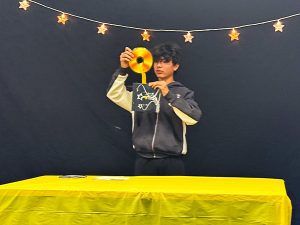
Her class worked for months to develop the show, which they built around core themes — defining AI and exploring its history, examining its role in creating misinformation, identifying the risks it poses to the environment and exposing the false humanity of chatbot companions. Students chose their topics and mastered 15 tricks to explain them. For example, a card trick demonstrated how algorithms function; a mix of images explained predictive AI, and color-changing discs mimicked how misinformation can shift perception.
Watch Sandler’s students use magic tricks to take the magic out of AI.
Bringing the show on the road
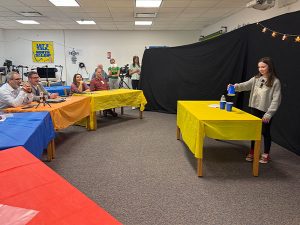
The class performed the show for faculty and staff earlier this year, and their tricks generated plenty of oohs and aahs. More importantly, all that abracadabra exposed AI “magic tricks” and invited careful observation and critical thinking. This provided food for thought on how we relate to technology. “The juxtaposition of how human a magic show is — performing illusions, talking to the audience — and how that contrasts with AI…. It was such a human way to talk about something that is so … not.”
Impressed school administrators invited the students to perform for the board of education at a meeting where AI was on the agenda. “You have an 11-year-old teaching the board of education things that they need to know,” Sandler said with pride.
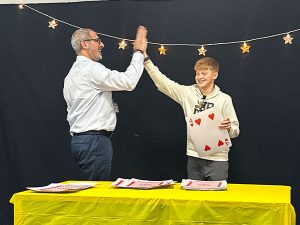
Photos courtesy Cynthia Sandler
Long before the curtain rose, she ensured that her students had a strong foundation in how the internet and AI systems work. “I really wanted them to know and understand that what they’re interacting with is not a person,” she said. ”We spend a lot of time talking about credibility and using strategies to assess it. In my class, they become empowered to fact-check themselves and to approach the media they see more critically.”
Relying on News Literacy Project resources
Such habits also are essential when interacting with AI. Yet, this is just a starting point. “You can’t stop there. The fact that most kids aren’t even getting the basics [of AI] is something we need to work on.”
But keeping up with the pace of change is not easy. “It’s a moving target. In one semester, the conversation about AI moved from cheating to transforming teaching and assessment, to prompt engineering to agentic AI.”
To stay current on AI and media literacy, Sandler relies on free resources from the News Literacy Project. ”I’m grateful for The Sift® and Rumor Guard® because they find student-friendly, age-appropriate media examples and news topics. And I really appreciate that, because it’s a full-time job. Having an organization like the News Literacy Project is invaluable in grounding us, giving us resources, providing support that’s timely.”