

The Sift: AI versus doctors


An educator's guide
to news literacy
April 20, 2026
Please share your opinion on The Sift in this survey. At the end you can enter to win one of 15 $100 Amazon gift cards. ☺️
In this issue
AI versus doctors | RumorGuard slides

Daily Do Now slides
A week’s worth of do-nows, just for you.

Top picks
Here are the latest news literacy topics and tips on how to integrate them into your classroom.

AI-generated text can sound convincing, even when making up reports.
1. Dad refused cancer treatment, citing AI chatbot
Joe Riley was a neuroscientist in Seattle who died of cancer last year. His adult son, Ben, said AI played a major role in his death.
- Trusting AI: Joe was convinced that his oncologist’s recommended treatment for the slow-moving cancer he was diagnosed with in 2024 would kill him, citing advice from Perplexity AI saying he had a rare complication. He refused treatment that his doctor recommended, leading to angry disagreements between Joe and Ben. Perplexity is a search engine powered by AI.
- Laying out facts: Ben contacted the researchers who published the study that the Perplexity chatbot cited as evidence for the complication — and they told him that the AI’s characterization of it was false and included some made-up details. This made no difference to Joe.
- Delayed treatment: About a year after his doctor recommended it, he finally agreed to receive care. By then he was much weaker and had to take a break in the treatments before he died.
- AI inaccuracies: Recent studies of leading AI chatbots found that they give misleading medical advice half of the time and misdiagnose over 80% of early medical cases.
💬 Discuss:
- What do you think causes people to sometimes believe AI-generated medical advice over their doctor? What role do past experiences with the medical system play into this dynamic?
- How would you respond if a loved one were favoring advice from AI over their doctor?
- Should governments regulate and monitor AI tools for medical misinformation? Why or why not?
💡 Idea: Have students ask an AI bot general wellness or medical questions like, “Should I wear sunscreen at the beach?” and “Is cooking with seed oils unhealthy?” Include some vague questions, like, “I have had a headache and been tired for three days. What’s wrong with me?” Then have students examine the AI-generated response for accuracy, using the “Levels of Scientific Evidence” infographic as a guide.
💡 Another idea: Use the “Reflect” slide in Week 22 of the Daily Do Now resource to explore this topic with students in 5-10 minutes.
⭐ NLP Resources:
- Infographic: “How to speak up without starting a showdown”
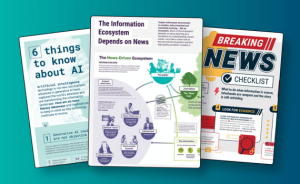
- Infographic: “6 things to know about AI”
- “Be Health Informed” (Checkology® virtual classroom)
🔗 Related:
- “Where Do Americans Get Health Information, and What Do They Trust?” (Pew Research Center)
- “What to know before asking an AI chatbot for health advice” (The Associated Press)
- “Woman, 23, Self-Diagnosed Her Rare Genetic Disorder Using ChatGPT After Years of Being Misdiagnosed by Doctors” (People)
2. Daily local newspaper saved by nonprofit
Pittsburgh won’t be losing its daily newspaper after all.
- Newspaper saved: The Pittsburgh Post-Gazette — one of the oldest newspapers in the U.S. — was sold to the nonprofit parent organization of The Baltimore Banner, a Maryland-based Pulitzer Prize-winning local news site. The Post-Gazette’s current owners said they chose the Venetoulis Institute for Local Journalism “as the best steward for the newspaper,” despite higher bids from other companies.
- Nearly closed: Before this deal, the 240-year-old Post-Gazette was set to close in May, leaving Pittsburgh as one of the largest American metropolitan areas without a daily local newspaper.
- New funding model: The Post-Gazette’s owners said they had spent $350 million on the paper over the past two decades and continued to lose money. The Venetoulis Institute relies on a mix of subscriptions, advertising and philanthropy to fund the local news organizations it owns and operates.
- Against the trend: The saving of the Post-Gazette runs counter to current trends. Almost 40% of local newspapers in the U.S. have closed since 2005.
💬 Discuss:
- Why does quality journalism cost money to produce? Why are local news outlets like the Post-Gazette struggling financially?
- Which funding model is the best for local news? Corporate, for-profit ownership? Nonprofit? Private owner (e.g., a wealthy family)? Something else?
- What do communities lose when their local paper shuts down?
⭐ NLP Resources:
- “Practicing Quality Journalism” (Checkology)
- Dig Deeper think sheet: “What is the role of local news in American Democracy?”
🔗 Related:
- “Condé Nast will close its women’s health magazine, Self, after 47 years” (The Guardian)
- “NPR receives $113 million in charitable gifts” (NPR)
3. ‘Pink slime’ spreads across the pond
The London Post and The Daily Brit may sound like the names of real news outlets, but they’re not.
- Pink slime isn’t journalism: Websites that masquerade as local news outlets are referred to as “pink slime.” They typically have the components of a legitimate news website — a masthead, headlines, sections and articles — but lack the core practices and values of journalism, such as transparency, independence and editorial integrity. Many use AI (without disclosure) to churn out cheap articles. But they generally have murky funding and an underlying partisan purpose: to promote specific candidates or causes over others.
- London example: This investigation by a London-based newspaper repeatedly found baffling content about wealthy people in Russia and former Soviet states published by a network of pink slime sites that seemed to be based in the UK, but actually turned out to be part of a Russian-owned “pink slime” network.
💬 Discuss:
- What are the differences between credible, standards-based news sites and pink slime sites?
- How could relying on pink slime sites for news affect you and your community?
💡 Idea: After explaining to students what “pink slime” news is and why it’s not reliable, ask them to find an article on a pink slime site — such as Courier or one of the many locally targeted sites from Metric Media — and analyze its credibility. What do they notice? How do these articles compare to real local news reporting?
⭐ NLP Resources:
🔗 Related:
- “The latest twist in Virginia’s redistricting battle: a ‘pink slime’ newspaper in Arlington” (ARLnow)
- “London news website publishes misleading ‘AI-generated fiction’” (Press Gazette)


These interactive slide decks help students think carefully and critically about viral claims in the digital age.
Fake NBA player quotes about Jaden Ivey circulate online

✅ YES: Former Chicago Bulls guard Jaden Ivey was waived from the team after posting several social media videos criticizing the NBA for celebrating Pride Month.
❌ NO: NBA players Kawhi Leonard, Patrick Williams and Tyrese Maxey did not say, “I stand with Jaden Ivey on everything he said. If they cut him, they might as well cut me too.”
✅ YES: This is a fabricated quote that also has been falsely attributed to other NBA players.
⭐ NewsLit takeaway:
Fabricating a quote to make it seem as if a well-known person endorsed or condemned a controversial position is a common tactic by purveyors of misinformation. To ensure these fake quotes reach the maximum number of viewers, they often are attributed to several notable people at once. Check out these Google Slides for tips to spot deceitful copypasta.
Misleading meme ties Artemis II lunar flight timing to ‘Dark Side of the Moon’ album

✅ YES: The 1973 rock album “The Dark Side of the Moon” by Pink Floyd has a runtime of about 42 minutes and 50 seconds.
✅ YES: The Orion spacecraft lost contact with Earth for 40 minutes as it passed by the moon and the entire trip took about 50 minutes during the Artemis II mission, according to NASA.
❌ NO: The trip’s duration didn’t match the album runtime. It was either slightly shorter or longer, depending on how it's measured.
✅ YES: The album’s music and lyrics have been a recurrent internet culture meme because of their apparent synchronicity with the 1939 film “The Wizard of Oz.”
⭐ NewsLit takeaway:
When a viral claim elicits a positive feeling or entertains us, we might be inclined to believe it since we want the information to be true. It’s important to slow down while scrolling on social media to examine claims and assess their credibility. Check out these Google Slides for tips to spot and debunk sensational statements.


➕ Can an AI chatbot “draw” a strawberry or share its favorite books with you? No, but humans can — and do — on Your AI Slop Bores Me, a website created by a teenager where humans pretend to be bots for fun.
➕ Large is “lahge” and flowers is “flowiz” in a Boston accent, charming viewers following a longtime Boston Globe journalist who reports the news with a local flavor in viral social media videos.
➕ FBI Director Kash Patel filed a $250 million defamation lawsuit against a veteran journalist and The Atlantic for publishing what Patel claims are false allegations. Both the journalist and the magazine stand by their reporting.
➕ TMZ may be a tabloid for celebrity gossip, but lately it’s also published paparazzi-like images of politicians on vacation during the partial government shutdown. This resonated with readers, leading to TMZ staffing a new team in Washington, D.C.
➕ A ProPublica reporter uncovered a new subject to investigate after getting some concerning queries: an impostor version of himself active on messaging apps soliciting military information.
➕ About 61% of elementary school teachers say their students struggle “a lot” to distinguish between AI-generated and authentic content, an EdWeek Research Center survey found.
➕ What is journalism? The New York Times answers this in its limited series on media literacy — which also includes suggested media literacy activities for students.
Thanks for reading!
Your weekly issue of The Sift is created by Susan Minichiello, Dan Evon, Peter Adams, Hannah Covington and Pamela Brunskill. It is edited by Lourdes Venard and Mary Kane.
You’ll find teachable moments from our previous issues in the archives. Send your suggestions and success stories to thesift@newslit.org.
Did someone forward you this newsletter? Subscribe to receive this newsletter in your inbox every Monday.
Check out NLP's Checkology virtual classroom, where students learn how to navigate today’s information landscape by developing news literacy skills.