
The Sift: Final issue: Top clicks in 2025-26


An educator's guide
to news literacy
May 18, 2026
Hi there,
It’s the last Sift of the 2025-26 school year!
Today we’re looking back at the most viewed resources and stories over the last year, but before we dive in:
🎁 Please share your thoughts in our Sift reader survey. You can enter to win one of 15 $100 Amazon gift cards at the end of the survey. Winners will be announced on June 4.
We’ll be back in your inbox at the beginning of the next school year. Have a great summer! 😎
— The Sift team
Top clicks
Artificial intelligence, breaking news events and press freedom issues were standout topics this school year.
These were the most clicked articles in The Sift:
- Charlie Kirk: Graphic images and video of the Sept. 10 fatal shooting of conservative activist Charlie Kirk spread quickly, even as traditional media was careful in what it shared, showing how media’s gatekeeping role is changing. This story about public figures showing support for Kirk’s family was viewed more than any other article this year in The Sift (Sept. 15 and Sept. 22 issues).
- AI music: It really happened. A song called Walk My Walk by AI-generated music persona Breaking Rust reached No. 1 on Billboard’s Country Digital Song Sales Chart (Nov. 17 issue).
- Mental health: Teens are hooked on social media, but research shows it comes at a cost to their mental health (Sept. 8 issue).
- AI slop: It’s hard to avoid AI slop, or low-quality synthetic content designed to grab attention and earn money online. The best-performing AI slop videos play on strong emotions, like fear, anger or sympathy (Oct. 27 issue).
- FBI raid: In an unusual move, the FBI raided a Washington Post reporter’s home and seized her laptops, her phone, a hard drive, a recording device and a Garmin watch. The raid raised concerns about press freedom in the U.S. (Jan. 26 issue).
➡️ Interested in browsing more past issues? Check out The Sift archive.

Most popular resources

The three most popular visual explainers used by Sift readers this year.
Here are the NLP classroom resources you loved most:
🔔 Daily Do Now: These 5- to 10-minute bell ringer activities reinforce news literacy concepts and can spark discussion at the beginning of class. Shared weekly in the same live Google Slides deck, Daily Do Now slides are by far the most viewed resource offered in this newsletter.
📜 Infographics: Artificial intelligence. Breaking news. Standards of quality journalism. Of all the infographics shared in The Sift, these were clicked on the most.
🌳 Information ecosystem: Is it news? Or is it content about news? This classroom activity analyzes examples of both. It’s designed to pair with “The Information Ecosystem Depends on News” poster. (Learn about the development of these resources in this Sift special issue.)
🧠 Pink slime quiz: This six-question quiz asks questions about characteristics of quality journalism and of pink slime sites with shared examples for students to examine. “Pink slime” sites masquerade as local news but are funded by political interests to publish propaganda.
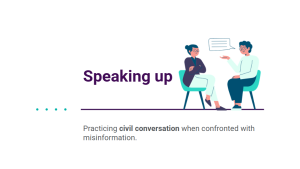
🗨️ Speaking up: A classroom activity for students to practice civil conversation when confronted by misinformation includes eight scenarios to role-play.


This was the most clicked RumorGuard slide deck this year.

AI-generated animals appeared to be a popular topic in this year’s RumorGuard slide decks.
These interactive slides show students how to think carefully and critically about viral claims they see online. Here were the most-viewed ones this year:
- “AI video of earthquake shaking up McDonald’s fries goes viral” (Feb. 9)
- “No, this Chihuahua didn’t join a wolf pack” (Sept. 22)
- “Real story, fake video: AI-generated clip depicts drunk raccoon” (Dec. 15)
- “No, AI robot didn’t get PTSD from lion encounter” (Sept. 15)
- “No, video of flight crew trying to avoid catastrophic accident isn’t real” (Feb. 23)
📌 Save this doc for links to all the RumorGuard slides decks from the 2025-26 school year.


Summer reading and listening list
Check out some of these news literacy-related pieces.
Journalism
- “How Does Journalism Earn Trust?” (Misguided: The Podcast)
- “Broadcasters must react to threat from ‘creator journalism’, says ex-head of BBC News” (The Guardian)
- “Journalism students know the industry is struggling. They’re choosing to enter it anyway” (Poynter)
Artificial intelligence
- “Inside a journalist’s year of using AI for (almost) everything” (NPR’s Fresh Air)
- “Prolific finance journalists facing questions over identities” (Press Gazette)
- “Help! My Kindergarten Is All In on AI.” (New York Magazine)
- “You can persuade AI models to accept falsehoods as truth, study shows” (The Conversation)
Social media
- “From Australia to Europe, countries move to curb children’s social media access” (Reuters)
- “Women lead as health and wellness influencers. Why do so many men have more followers?” (The 19th)
Misinformation
- “The Hantavirus Outbreak Is Resurrecting Covid-Era Misinformation Tactics” (The New York Times)
- “Many Americans think Trump assassination attempts were fake, survey finds” (The Washington Post)
How do you like this newsletter?

Thanks for reading!
Your weekly issue of The Sift is created by Susan Minichiello, Dan Evon, Peter Adams, Hannah Covington and Pamela Brunskill. It is edited by Lourdes Venard and Mary Kane.
You’ll find teachable moments from our previous issues in the archives. Send your suggestions and success stories to thesift@newslit.org.
Did someone forward you this newsletter? Subscribe to receive this newsletter in your inbox every Monday.
Check out NLP's Checkology virtual classroom, where students learn how to navigate today’s information landscape by developing news literacy skills.